
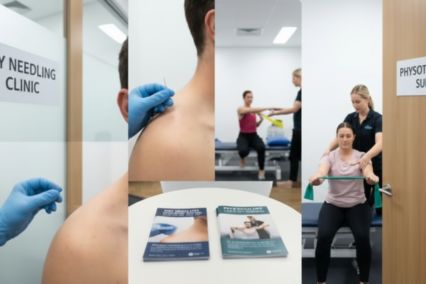
Muscle tightness, stubborn pain, or an injury can make it difficult to decide what treatment you actually need. You may have heard about dry needling and wondered whether it is better to start with that or book a physiotherapy appointment.
The answer depends on the problem.
Dry needling and physiotherapy are not really competing treatments. Dry needling is a specific treatment technique, while physiotherapy is a broader approach to assessing and managing pain, movement problems, injuries, and rehabilitation. Arka Physiotherapy describes dry needling/IMS as an advanced technique that can be used within physiotherapy care.
Understanding that difference can make it easier to choose the right starting point.
What Is Dry Needling?
Dry needling is a technique that uses thin, sterile needles to target specific muscles and trigger points. Arka Physiotherapy also refers to the treatment as Intramuscular Stimulation (IMS) and describes its use for muscle tension, trigger points and movement-related problems.
Unlike an injection, dry needling does not involve injecting medication into the tissue.
The aim of treatment depends on the individual’s condition. A physiotherapist may use dry needling to address areas of muscle tightness or sensitivity that are contributing to pain or restricted movement.
Arka lists dry needling/IMS among its physiotherapy services and describes it as an option for conditions involving muscle tension, musculoskeletal pain, sports injuries and trigger-point pain.
Dry needling is therefore best understood as one tool within a rehabilitation plan, rather than a complete rehabilitation program by itself.
What Is Physiotherapy?
Physiotherapy involves much more than treating one painful muscle.
At Arka Physiotherapy, treatment begins with assessment and can include patient education, therapeutic exercise, functional training and hands-on manual therapy. Depending on the person’s needs, treatment may also include joint mobilization, soft-tissue techniques and other physiotherapy modalities.
The broader goals are to reduce pain, improve movement, build strength, restore physical function and help patients return to everyday activities.
Physiotherapy can be used for a wide range of problems. Arka lists conditions including sports injuries, muscle strains, neck pain, low back pain, shoulder pain, arthritis, headaches, sciatica, knee and ankle problems, post-surgical rehabilitation and work-related injuries.
Dry Needling vs Physiotherapy: What Is the Difference?
|
Feature |
Dry Needling / IMS |
Physiotherapy |
|---|---|---|
|
Main approach |
Uses fine needles to target selected muscle areas and trigger points |
Uses assessment plus exercise, manual therapy, education, functional training and other techniques |
|
Main focus |
Muscle tightness, trigger points and related pain or movement limitations |
Pain, movement, strength, function and rehabilitation |
|
Scope |
A specific treatment technique |
A broader rehabilitation approach |
|
May be considered for |
Muscle tightness, trigger-point pain and some sports or musculoskeletal problems |
Injuries, post-surgical rehabilitation, joint problems, mobility limitations and many other conditions |
|
Can they be combined? |
Yes |
Yes |
Which Should You Try First?
This depends on what is actually causing your symptoms.
Arka’s article suggests that someone with sudden muscular soreness or tight knots that are restricting movement may be a candidate for dry needling, while physiotherapy is a stronger starting point for injury recovery, post-surgical rehabilitation or longer-term mobility limitations.
A physiotherapy assessment can help determine which approach makes sense.
For example, imagine that your neck feels extremely tight after prolonged desk work. If specific muscles are particularly sensitive or tight, dry needling may be considered as part of treatment.
Now consider someone recovering from a knee injury. Pain may be only one part of the problem. They may also have reduced strength, limited range of motion, difficulty using stairs or difficulty returning to work or sport. In that situation, a rehabilitation program involving exercise and functional training may be more central to recovery.
The treatment should fit the problem rather than choosing a technique simply because it is popular.
Can Dry Needling and Physiotherapy Be Used Together?
Yes.
In fact, this is one of the most important points to understand about dry needling.
Dry needling does not have to replace exercise or other physiotherapy techniques. It may be incorporated into a wider treatment plan when the physiotherapist believes it is appropriate.
Arka specifically states that dry needling can be combined with treatments such as exercise and manual therapy.
Research also supports a more nuanced view. A recent systematic review examining dry needling and exercise for musculoskeletal pain found that most included studies did not show an additional benefit from dry needling over exercise alone, although some studies found better outcomes when dry needling was combined with exercise for particular conditions.
That means the question should not be simply, “Should I get dry needling?”
A better question is: “Would dry needling add value to the rehabilitation plan for my condition?”
What Conditions May Be Treated With Dry Needling?
Arka Physiotherapy lists several situations in which dry needling/IMS may be considered, including muscle tension, chronic pain conditions, sports injuries and post-surgical recovery.
- Lower back pain
- Neck pain
- Shoulder pain
- Tendon-related problems such as tennis elbow or Achilles tendinitis
- Sports injuries
- Trigger-point and myofascial pain
- Tension-type headaches and migraines
However, having one of these conditions does not automatically mean dry needling is appropriate.
The suitability of any treatment depends on the patient’s presentation, clinical assessment, medical history, goals and other factors. Evidence also varies between different pain conditions, so claims about effectiveness should not be generalized from one body area to another.
What Does Physiotherapy Treat?
Physiotherapy has a much broader range of applications.
Arka’s physiotherapy service covers tendon and ligament disorders, muscle injuries, pain conditions, joint problems and several inflammatory or movement-related conditions.
Muscle and Soft-Tissue Problems
Physiotherapy may be used for muscle strains, bruises, contractures, spasms and other muscle-related conditions.
Joint and Orthopaedic Problems
Arka treats conditions including osteoarthritis, dislocations and ligament injuries.
Persistent Pain and Movement Problems
The clinic lists headaches, myofascial pain, neck pain and lower back pain among its treatment areas.
Rehabilitation After Injury or Surgery
Physiotherapy can focus on restoring strength, movement and functional abilities after an injury or surgery. Arka specifically lists post-surgical rehabilitation among its services and conditions treated.
Does Dry Needling Hurt?
People experience dry needling differently.
Arka says most patients experience little discomfort when the needle is inserted, although some may experience a brief cramping or twitching sensation. Temporary muscle soreness afterward is also described by the clinic.
As with any invasive technique, a patient should be given an opportunity to ask questions and discuss relevant health information before treatment.
Dry needling is not something you need to choose simply because you are experiencing pain. A qualified practitioner should determine whether it is appropriate for your particular situation.
Are There Side Effects?
Minor effects can occur after dry needling.
Arka’s Dry Needling/IMS service page lists temporary soreness, bruising and minor bleeding among possible effects and states that serious complications are rare.
Because dry needling involves inserting a needle below the skin, appropriate training, anatomical knowledge and clinical judgment matter.
This is also reflected in British Columbia’s current regulatory framework. Under the Health and Care Professionals Regulation, a certified physical therapist may perform a procedure below the dermis using solid filament needles for reducing inflammation or managing pain.
Patients should therefore make sure the practitioner performing the procedure is appropriately qualified and authorized to provide it.
Dry Needling vs Acupuncture: Are They the Same?
No.
Both treatments use needles, but they are based on different approaches.
Arka describes acupuncture as being based on Traditional Chinese Medicine concepts, while dry needling uses an anatomy- and musculoskeletal-focused approach to target muscles and relevant tissues.
The Canadian Physiotherapy Association also recognizes dry needling and acupuncture as techniques that may be incorporated into physiotherapy practice, subject to the requirements of the applicable jurisdiction and the physiotherapist’s education and training.
The important point for patients is to understand which technique is being offered, why it has been recommended, and who is qualified to provide it.
What Happens During Physiotherapy?
A physiotherapy appointment usually involves more than treating the painful area.
Arka says the first visit includes assessment of the patient’s medical history and physical condition, discussion of goals and development of a personalized treatment plan.
Treatment may then include:
- Therapeutic exercises
- Manual therapy
- Functional training
- Joint mobilization
- Soft-tissue techniques
- Education about movement and recovery
- Other modalities where appropriate
This broader assessment helps explain why physiotherapy can be useful when pain is accompanied by weakness, restricted movement or difficulty performing daily activities.
Why Exercise Is Still Part of Recovery
It is easy to focus on passive treatments when you are in pain. But rehabilitation often requires rebuilding the body’s ability to move and handle normal activity.
Arka includes customized therapeutic exercise and functional training among the foundations of its physiotherapy approach. These programs are intended to improve strength, flexibility and physical function and help patients return to everyday activities and work.
Dry needling can be considered alongside these strategies when appropriate. It does not make the need for rehabilitation disappear.
Current research reinforces this distinction: exercise remains an important part of musculoskeletal rehabilitation, and dry needling does not consistently provide an additional benefit over exercise alone across conditions.
How to Decide What Treatment You Need
Choosing between dry needling and physiotherapy becomes easier when you start with your actual goal.
Is my main problem a tight, painful muscle? A physiotherapist may consider dry needling if the assessment supports it.
Am I recovering from an injury or surgery? A broader physiotherapy program may be needed to restore movement, strength and function.
Is my pain affecting work, exercise or daily activities? Assessment and rehabilitation can help identify what needs to change.
Do I want to know why the pain keeps returning? A physiotherapy assessment can look beyond the immediate painful area and evaluate movement, strength and functional factors.
You may not need to choose one treatment before your assessment.
Why Choose Arka Physiotherapy for Dry Needling and Rehabilitation?
Arka Physiotherapy is located at Unit 106, 14818 60 Avenue, Surrey, BC and offers physiotherapy alongside Dry Needling/IMS, manual therapy, active rehabilitation, massage therapy, vestibular therapy, pelvic floor physiotherapy, TMJ care and other services.
The clinic describes its approach as personalized and evidence-based, with one-on-one treatment sessions. It also states that patients can book directly without a physician referral and that it provides direct billing support for ICBC, WorkSafeBC and major insurance providers.
For someone unsure whether dry needling, conventional physiotherapy or a combination would be appropriate, an assessment can help determine the next step.
Dry Needling vs Physiotherapy: The Key Takeaway
Dry needling and physiotherapy are not two identical treatment choices.
Dry needling is a specific technique that may target tight muscles and trigger points. Physiotherapy is a broader approach that can include assessment, exercise, manual therapy, functional training and education.
Arka Physiotherapy positions Dry Needling/IMS as part of physiotherapy care rather than a replacement for rehabilitation.
For some patients, dry needling may be a useful addition when muscle tightness or trigger-point pain is affecting movement. For others, exercise, manual therapy, functional rehabilitation or another treatment approach may be more appropriate.
The best starting point is therefore not necessarily the treatment that sounds quickest. It is the treatment plan that matches your condition, goals and assessment.
At Arka Physiotherapy, a physiotherapist can assess your symptoms and discuss whether dry needling/IMS, physiotherapy or a combination of approaches is suitable for your needs.
Frequently Asked Questions
Is dry needling the same as physiotherapy?
No. Dry needling is a specific technique, while physiotherapy is a broader healthcare and rehabilitation approach. Arka describes Dry Needling/IMS as an advanced technique that can be used within physiotherapy treatment.
Is dry needling better than physiotherapy?
There is no general answer that dry needling is better. They serve different purposes. Dry needling may be useful for selected muscle and trigger-point problems, while physiotherapy addresses broader issues such as strength, mobility and function.
Can I have dry needling and physiotherapy in the same treatment plan?
Yes. Dry needling may be combined with exercise, manual therapy and other physiotherapy treatments when clinically appropriate. Arka specifically describes it as a complementary treatment option.
Does dry needling hurt?
It can cause a brief prick, cramping or muscle-twitching sensation. Temporary soreness after treatment can also occur. Individual experiences vary.
How long does soreness after dry needling last?
Arka’s comparison article describes muscle soreness as commonly occurring for around 24 hours after treatment. Individual recovery can differ, so patients should follow the instructions provided by their practitioner.
Can dry needling help muscle tightness?
Dry needling is specifically used to target selected muscles and trigger points, and Arka lists chronic muscle tightness among the situations in which it may be considered.
Can dry needling replace exercise?
Not generally. Physiotherapy may include exercises designed to improve strength, flexibility and physical function. Current evidence does not show a consistent additional benefit from adding dry needling to exercise for all musculoskeletal conditions.
Is dry needling the same as acupuncture?
No. Although both use needles, they have different clinical frameworks. Arka describes dry needling as an anatomy- and musculoskeletal-focused technique, while acupuncture is associated with Traditional Chinese Medicine.
Do I need a doctor’s referral to see Arka Physiotherapy?
Arka states that a physician referral is not required to book physiotherapy at the clinic. Insurance reimbursement requirements can differ, so patients should check their individual plan when relevant.
Can dry needling be covered by insurance?
Coverage depends on the insurance plan and how the service is classified. Arka’s article recommends checking with your insurance provider before the appointment. The clinic also offers direct billing support for several insurers and programs.
Where is Arka Physiotherapy located?
Arka Physiotherapy is located at Unit 106, 14818 60 Avenue, Surrey, BC V3S 0B5, Canada. The clinic’s listed phone number is +1 778 564 5999.