
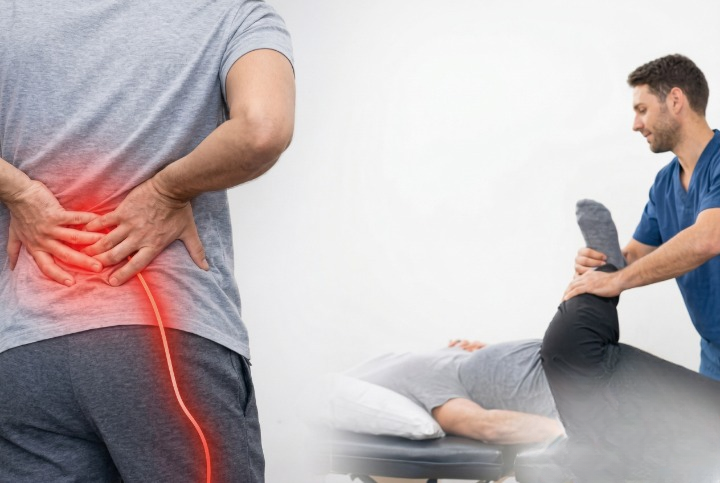
If you’re typing physiotherapy near me into Google, it’s usually because your back pain is dragging on, or you’ve got leg symptoms that feel sharp, burning, or electric. You want relief, but you also want to know what’s happening and how to stop it from coming back.
This blog covers:
- what back pain and sciatica actually mean
- what usually drives symptoms
- what helps (and what commonly makes it worse)
- when you need urgent medical care
- what a good physiotherapy plan looks like
No hype. No miracle claims. Just practical direction.
Back pain vs. sciatica: what’s the difference?
Low back pain
Low back pain is pain mainly felt in the lower back area. It can be dull, stiff, sharp, or “caught.” It might stay in one spot or spread into the buttock or hip.
A lot of low back pain improves with basic self-care and a sensible return to movement. HealthLinkBC notes that most low back pain improves with self-care like heat/ice and light activity such as walking.
Sciatica (often called nerve root irritation or “radicular pain”)
Sciatica usually means symptoms that travel from the low back or buttock down the leg, often with tingling, numbness, or burning. Sometimes there’s weakness.
HealthLinkBC describes that sciatica symptoms may worsen with sitting, prolonged standing, or movements that flex the spine (like knee-to-chest) and may feel relieved by walking, lying down, or movements that extend the spine for some people.
Key point: not all leg pain is sciatica. You can get referred pain into the buttock/leg without nerve involvement. That’s why a proper assessment matters.
Common causes (and why most self-diagnoses are wrong)
1) Disc irritation (sometimes)
Sciatica is often linked to a bulging or herniated disc irritating a nerve root. HealthLinkBC lists a bulging or ruptured disc as a usual cause.
But here’s the part people miss: the word “disc” doesn’t automatically mean you’re damaged forever. Many disc-related flare-ups settle with the right loading plan.
2) Arthritis or narrowing (stenosis), bone spurs (sometimes)
HealthLinkBC also notes bone spurs (from arthritis/stenosis) as a possible cause.
This tends to show up more with age, but symptoms can still be managed well with the right approach.
3) Joint and soft-tissue pain (very common)
Facet joint irritation, SI region sensitivity, hip stiffness, muscle guarding, and tendon irritation can all present as “back pain” or “back + buttock pain.” This is common, and usually responds to movement changes, graded strengthening, and time.
4) Nerve sensitivity (more common than people think)
Nerves can be irritable without being “pinched.” When that’s the case, aggressive stretching or forcing range often backfires. The right plan calms the system first, then rebuilds capacity.
5) Load spikes and the boom–bust cycle
A classic pattern:
- you feel a bit better
- you do a lot
- it flares hard
- you rest too much
- you stiffen up
- repeat
If that sounds like you, you’re exactly the person searching physiotherapy near me who benefits from pacing + progressive loading, not random YouTube stretches.
Red flags: when back pain or sciatica needs urgent medical care
Get urgent assessment if you have:
- new loss of bowel or bladder control
- numbness in the saddle area (groin/inner thighs)
- rapidly worsening weakness, foot drop, or you can’t lift your foot
- severe symptoms after significant trauma
- fever/chills, unexplained weight loss, or you feel systemically unwell with back pain
If you’re unsure, don’t guess. Get checked.
What to do at home in the first 48–72 hours
If your pain is acute, your job is simple: calm things down without becoming inactive.
1) Use heat or ice if it helps
HealthLinkBC provides practical guidance on using heat or ice.
Use whichever gives you relief. Don’t overthink it.
2) Keep moving, but stop provoking flares
HealthLinkBC notes low back pain often improves with self-care including light activity such as walking. (HealthLink BC)
This doesn’t mean forcing through pain. It means staying active within tolerance:
- short walks more often
- change positions regularly
- avoid long sitting if it spikes symptoms
3) Don’t build your plan around bed rest
Choosing Wisely Canada points out that many people do not get better faster with unnecessary tests, and emphasizes simple steps like applying heat and staying active.
Translation: lying down all day usually makes you stiffer and less confident moving.
4) Be careful with stretching if symptoms go down the leg
If leg symptoms are sharp, burning, or tingling, aggressive hamstring stretching can flare things. Your nervous system may not want “more stretch” right now.
5) Reduce “pressure spikes” when possible
HealthLinkBC notes sciatica symptoms can worsen with sneezing/coughing/straining and heavy lifting.
You don’t need to be fragile, but this is why bracing, pacing, and avoiding max lifts early can help.
What physiotherapy near me should include
If you’re paying for physiotherapy, you should get more than a heat pack and a generic handout. A proper plan usually has five parts.
1) A real assessment (not a 5-minute guess)
A good physio will look at:
- what positions and movements change symptoms (sitting, bending, walking, stairs)
- whether symptoms are back-dominant, nerve-dominant, or mixed
- strength, sensation, reflexes when appropriate
- how you hinge, squat, move, and load your spine
- work demands, sleep, training history, and recent load changes
This matters because “back pain” is not one condition, and sciatica is not one condition.
2) Clear symptom-control strategies you can repeat at home
This might include:
- movement directions that reduce symptoms (not random exercise variety)
- pacing rules (how much walking/sitting/lifting is okay this week)
- sleep and sitting setups that reduce irritation
- if appropriate, gentle nerve mobility (dosed carefully)
You should leave with a plan you can actually do.
3) Progressive strengthening and capacity building
This is the part that prevents recurrence.
The Government of Canada’s back safety guidance highlights reducing risk by staying in shape with regular exercise, improving muscle strength (especially abdominal muscles), and using proper lifting techniques. (Canada)
That’s the backbone of prevention: strength + tolerance + better load management.
A smart program usually builds:
- hip strength and trunk control
- tolerance to bending/hinging and lifting for your life
- a graded return to work tasks or sport
- walking or conditioning that progresses without flare-ups
4) Hands-on therapy (optional, not the whole plan)
Manual therapy can reduce pain for some people and make movement easier short-term. It should support the active plan, not replace it.
If the clinic’s entire strategy is passive treatment forever, you’re not being rehabbed. You’re being retained.
5) Clear rules for flare-ups
Back pain and sciatica can fluctuate. A good physiotherapist teaches you:
- what a normal flare looks like
- how to modify activity for 24–72 hours
- when to push, when to back off
- when symptoms are not “normal” and need medical escalation
That’s how you stop panicking every time it bites.
Do you need an MRI before starting physiotherapy?
Usually, no.
Choosing Wisely Canada’s patient guidance explains that imaging tests (X-ray/CT/MRI) usually don’t help you get better faster for typical lower back pain, and can lead to additional procedures that complicate recovery.
HealthLinkBC also notes most people don’t need tests right away, and that imaging may be considered if pain lasts more than about 6 weeks.
When imaging is more reasonable:
- red flags
- significant or worsening neurological signs (progressive weakness/numbness)
- symptoms not improving as expected and results would change medical management
A physio can help triage and recommend medical follow-up when appropriate, but imaging decisions ultimately belong with your physician or specialist.
How long does recovery take?
There’s no honest one-size timeline. But some useful expectations:
- Most non-specific low back pain improves with self-care and gradual return to movement. HealthLinkBC states most low back pain improves with self-care like heat/ice and walking.
- Sciatica can improve steadily, but it often needs more careful pacing and loading.
The real measure is trend, not the calendar:
- Are symptoms less intense?
- Are flare-ups shorter?
- Can you walk farther or sit longer than last week?
- Is pain travelling less far down the leg?
Those are meaningful wins.
How to choose the right clinic when searching “physiotherapy near me”
Use this checklist. It’s blunt because it needs to be.
Pick a clinic where:
- they assess properly and explain clearly
- you get an individualized plan, not a template
- you’re progressed over time (strength, tolerance, return to activity)
- they track function (walking, work tasks, sleep, lifting tolerance)
- they tell you when you need medical referral
Avoid clinics where:
- the plan is all passive treatment, indefinitely
- nobody talks about return-to-activity loading
- you’re told you’re “out of alignment” and need endless fixing
- you’re promised a cure in a fixed number of visits
That’s not healthcare. That’s a sales model.
1) Is sciatica always caused by a herniated disc?
No. A disc bulge/herniation is a common cause, but HealthLinkBC also lists bone spurs/stenosis, compressed nerve roots from injury, pregnancy, and rare tumours as possible causes. (HealthLink BC)
Your symptom pattern and exam findings matter.
2) Should I rest until my back pain is gone?
Usually not. Most low back pain improves with self-care and light activity such as walking. (HealthLink BC)
Resting too much tends to reduce tolerance and confidence.
3) Why does sitting make my sciatica worse?
Sciatica symptoms may worsen with sitting, prolonged standing, or movements that flex the spine, according to HealthLinkBC. (HealthLink BC)
Your plan should reduce irritability first, then gradually build tolerance to sitting again.
4) Do I need an X-ray or MRI before I book physiotherapy near me?
Often no. Choosing Wisely Canada explains imaging usually doesn’t help people recover faster in typical lower back pain and can lead to unnecessary follow-up.
Imaging may be appropriate when red flags or worsening neurological symptoms are present.
5) What’s one thing I can do today while I search physiotherapy near me?
Walk in short doses and avoid long sitting if it spikes symptoms. HealthLinkBC notes light activity such as walking is part of self-care that helps most low back pain.
Keep it tolerable and repeatable.
References (Canadian)
- HealthLinkBC — Low Back Pain (HealthLink BC)
- HealthLinkBC — Sciatica (HealthLink BC)
- Choosing Wisely Canada — Imaging Tests for Lower Back Pain (Choosing Wisely Canada)