
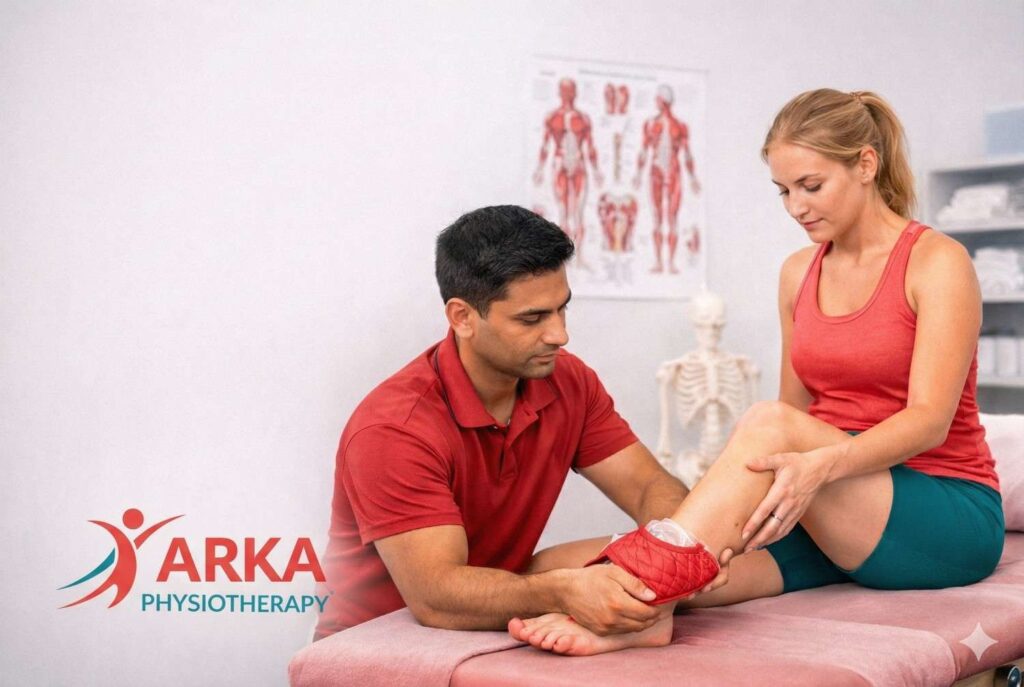
If you’ve ever rolled your ankle stepping off a curb, hopping off a bus, or landing awkwardly during a weekend game, you know how fast an ankle sprain can ruin your day. One second you’re fine… the next you’re limping, wincing, and wondering whether you should “walk it off” or start panic-Googling “ankle sprain vs fracture” at 2 a.m.
Here’s the reassuring truth: ankle sprains are incredibly common, and most people recover well. But they’re also one of those injuries that can linger if the ankle doesn’t fully regain its mobility, strength, balance, and confidence. That’s why some people feel “mostly fine” on flat ground… but still feel unstable on stairs, uneven sidewalks, or trails.
This blog is a friendly, plain-language guide to ankle sprains—what’s happening inside the joint, what to do in the first few days, what not to do, and how physiotherapy can help you heal properly and reduce your chance of spraining it again.
What Is an Ankle Sprain?
An ankle sprain is an injury to the ligaments in your ankle. Ligaments are strong bands that connect bone to bone and help keep your joint stable.
Most ankle sprains happen when your foot rolls inward/outward—your weight shifts onto the edge of the foot—and the ligaments on the outside/inside of the ankle get stretched or torn. That’s why pain often shows up near the outer/inner bony bump.
Not every ankle injury is a straightforward sprain, though. Sometimes there can be:
- A small fracture (bone break)
- A tendon injury (irritation or tearing)
- Cartilage irritation inside the joint
- A “high ankle sprain” (higher up between the shin bones)
This is why getting assessed can be helpful—especially if the pain is severe, or things aren’t improving.
Common Symptoms of an Ankle Sprain
Ankle sprains can vary a lot, but common symptoms include:
- Pain (often on the side of the ankle)
- Swelling
- Bruising (sometimes appears hours later)
- Stiffness and reduced range of motion
- A feeling of instability (“I don’t trust it”)
- Difficulty walking or bearing weight
And yes—ankle sprains can feel dramatic. Even a mild sprain can throb and swell more than you’d expect.
Do I Need to Get My Ankle Checked?
Sometimes people try to tough it out for weeks, hoping it’ll settle. But some ankle injuries should be assessed sooner, especially if there’s a risk of fracture or more serious damage.
Get it checked promptly if:
- You can’t take four steps without significant pain
- Pain is directly over the bone (not just soft tissue)
- Swelling is immediate and intense
- Your foot feels numb, cold, or looks unusually pale
- You heard a loud “pop” and instantly couldn’t walk
- Symptoms aren’t improving after about 5–7 days
A physiotherapist can screen the injury and let you know if you should get imaging like an X-ray.
Ankle Sprain Treatment: What to Do in the First 24–72 Hours
There’s a lot of mixed advice online, so here’s a simple, realistic approach:
calm it down, protect it, and keep it gently moving.
1) Protect the ankle (but don’t freeze it in place forever)
If walking hurts, it’s okay to:
- Use a brace or wrap
- Reduce walking distances temporarily
- Use crutches briefly if you’re limping heavily
The goal is to avoid repeatedly stressing the ligaments early on, while still keeping the ankle from getting overly stiff.
2) Relative rest (not total rest)
“Relative rest” means avoiding painful movements but still moving within comfort. Total rest can make your ankle stiff and slow recovery.
3) Compression and elevation
If your ankle is swollen, these are your best friends:
- Compression (ankle sleeve or elastic wrap) helps control swelling.
- Elevation (foot above heart level) helps fluid drain.
4) Ice (optional)
Ice can help with pain relief for some people. If it feels good, use it:
- 10–15 minutes at a time
- Avoid putting ice directly on skin
5) Gentle movement
Even early on, gentle movement can help reduce stiffness:
- Slow ankle circles
- “Alphabet” with your foot
- Gentle point-and-flex motions
If it’s sharp pain, ease off. If it’s mostly stiffness, gentle movement is usually helpful.
Common Mistakes That Slow Recovery
These are easy traps, especially when life is busy.
Mistake #1: “I’ll just walk it off.”
If you limp heavily for days, your body adapts to the limp—and that can lead to knee, hip, or back pain.
Mistake #2: Waiting until it feels “okay,” then jumping back into activity
Walking on flat ground is one thing. Stairs, uneven sidewalks, wet pavement, and quick movements are a whole different level.
Mistake #3: Only stretching
Mobility matters, but sprains usually need strength + balance + control too.
Mistake #4: Skipping balance training
An ankle sprain affects proprioception (your ankle’s ability to sense position). Without retraining, your ankle can feel unpredictable and more likely to roll again.
Why Ankle Sprains Keep Coming Back
An ankle sprain isn’t just a ligament problem. It can affect:
- Mobility (especially dorsiflexion—your ankle bending upward)
- Strength (ankle and calf muscles)
- Proprioception (balance and joint awareness)
- Coordination (how quickly the ankle reacts)
- Confidence (you can’t underestimate this!)
A lot of people feel okay on smooth indoor floors, but notice trouble on uneven ground—like parks, trails, gravel paths, and surprise sidewalk cracks.
Physiotherapy for Ankle Sprain Recovery: How Physiotherapy Helps (In Real-Life Terms)
Physiotherapy isn’t just “here are a few exercises.” It’s a step-by-step plan tailored to your injury and your life—whether you want to walk comfortably, keep up with long work shifts, get back to the gym, or return to sports.
1) A Proper Assessment and Clear Recovery Plan
A physiotherapist will assess:
- Where the pain is (ligament vs tendon vs joint vs bone)
- Swelling/bruising patterns
- Range of motion (especially dorsiflexion)
- Strength of the ankle and calf
- Balance and stability
- Walking pattern and compensations
- Previous sprains (important!)
This helps you stop guessing and start recovering with a plan.
2) Reducing Swelling and Restoring Mobility
Early rehab often includes:
- Gentle range-of-motion exercises
- Advice for safe walking and activity modification
- Manual therapy when appropriate
- Strategies to manage swelling
A key movement is restoring ankle dorsiflexion (knee over toes). Limited dorsiflexion can make stairs, squatting, and running feel awkward.
3) Strengthening That Actually Supports Your Ankle
Rehab often includes:
- Calf strengthening (straight-knee and bent-knee)
- Strengthening the muscles on the outside of the ankle (important for preventing rolling)
- Foot strengthening (arch control)
- Hip strengthening (hips influence ankle alignment and control)
It’s progressed gradually, so you build real stability—not just temporary relief.
4) Balance and Proprioception Training (The “Secret Sauce”)
Balance retraining is a big reason physiotherapy reduces re-injury risk.
You might start with:
- Single-leg balance
- Balance on a cushion/unstable surface
- Reaching tasks
Then progress to:
- Stepping drills
- Hopping patterns
- Agility work (depending on your goals)
This is what helps your ankle react better on uneven ground—like trails, gravel paths, and surprise sidewalk cracks.
5) Return-to-Activity Guidance (So You Don’t Have to Guess)
A physiotherapist can help you return safely using milestones like:
- Walking briskly without a limp
- Full ankle range of motion compared to the other side
- Strong, pain-free heel raises
- Stable single-leg balance
- Controlled hopping/jumping (if needed)
If your goal is hiking around Surrey or returning to sports, your plan can include graded progressions for uneven terrain, quicker direction changes, and confidence-building drills.
6) Bracing and Taping When It Helps
Sometimes a brace or taping can help early on or during return to sport. The goal is to support the ankle while you rebuild strength and control—then gradually rely less on external support as your ankle becomes more resilient.
How Long Does Ankle Sprain Recovery Take?
Timelines vary, but generally:
- Mild sprain: 1–3 weeks
- Moderate sprain: 3–8 weeks
- Severe sprain: 8–12+ weeks
But the best marker isn’t the calendar—it’s function: walking normally, good mobility, strength, balance, and confidence.
Ankle Sprain FAQ (Quick Answers)
Should I ice it?
If ice helps your pain, yes. Ice is mainly for comfort. Use it 10–15 minutes at a time and avoid direct skin contact. If ice doesn’t help, you don’t have to force it.
Should I stretch it?
Gentle movement is usually helpful, especially for stiffness. But aggressive stretching early on can irritate the ankle. A physiotherapist can guide you on the right mobility work—especially if you’ve lost dorsiflexion.
Do I need an X-ray?
Not everyone does. You may need imaging if:
- You can’t take four steps
- Pain is directly on the bone
- Swelling is intense and immediate
- Symptoms aren’t improving after about a week
A physiotherapist can screen the injury and advise if you should seek an X-ray.
The Bottom Line
Most ankle sprains recover well—but the best recoveries happen when you restore the full package: mobility, strength, balance, and confidence. If your ankle still feels stiff, weak, wobbly, or you’ve sprained it before, physiotherapy can make a huge difference.
Ready to Feel Steady on Your Feet Again? Book with Arka Physiotherapy in Surrey
If you’ve recently sprained your ankle—or it’s been weeks and it still doesn’t feel right—our team at Arka Physiotherapy can help you recover safely and confidently.
We support people across Surrey, including Panorama, Sullivan, and the Highway 10 area, with personalized ankle sprain rehabilitation that focuses on:
- reducing pain and swelling
- restoring mobility
- rebuilding strength and balance
- helping you return to walking, work, and activities without fear of rolling it again
?Book online to get started, call us if you’d like help choosing the right appointment, or visit Arka Physiotherapy in Surrey (Panorama / Sullivan / Highway 10 area).
If you share your booking link, phone number, and exact clinic address(es), I’ll plug them into this call-to-action so it’s ready to publish exactly as-is.